
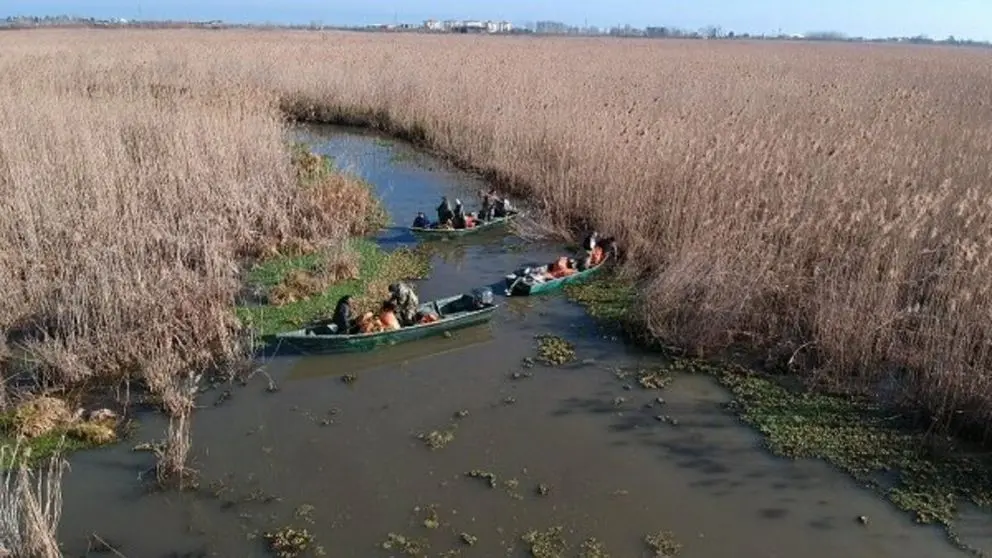
Hadi Haghshenas, the Governor of Gilan province, announced that the depth of the Anzali Lagoon, which was once more than 10 meters, has now dropped to less than 20 centimeters in many areas and has completely dried up in some spots.
Speaking on Sunday, the 16th of Dey, about the cause of the Anzali Lagoon drying up, he said: “Lake Urmia and the Anzali Lagoon are different from one another. Lake Urmia dried up because water stopped reaching it. Water does flow into the Anzali Lagoon, but because of sediment build-up in the lagoon, the water moves on toward the sea. The retention time of water in the Anzali Lagoon is negligible.”
Haghshenas added: “The main solution is to treat industrial wastewater, complete the treatment plant for Rasht's industrial estate, and carry out the treatment-plant projects in Rasht, Anzali, Sowmeh Sara, Masal, Fuman, Rezvanshahr, and Shaft.”
Earlier, in the month of Tir, Hamidreza Fathshirin, managing director of the Anzali Boatmen's Union, warned against inexperienced management structures making poor decisions and said that “all the sewage” is being discharged into the Anzali Lagoon without any oversight.
The Anzali Lagoon covers more than 24,000 hectares, part of which extends to Pirbazar and Zarjub, and it receives a portion of the provincial capital's sewage.
According to Fathshirin, this part of the lagoon is polluted, with no fish or other living creatures left in it, and whenever it rains, the sewage is pushed toward the sea: “Farmers also use this same water, which has sewage mixed into it, to irrigate their crops, and these very crops are then consumed by the public.”
The Governor of Gilan went on to acknowledge that water and sewage projects, along with industrial and residential treatment plants in the province, have either not been carried out or have been left half-finished.
He had previously warned that Rasht and Anzali would become “uninhabitable” within three years. Commenting on that earlier statement, he said: “The number three is symbolic. The main point is that human sewage, agricultural runoff, and wastewater from the industrial estate — from the cities and villages of Rasht, Anzali, Sowmeh Sara, Masal, Fuman, Shaft, and others — together with sewage from a considerable number of other villages, flow toward the Anzali Lagoon via rivers such as the Zarjub and the Goharrud.”
In the month of Esfand 1402 (early 2024), Japan's ambassador to Tehran announced his country's readiness to cooperate in restoring Lake Urmia and various other wetlands, including the Anzali Lagoon.
Lake Urmia and the Anzali Lagoon are not Iran's only dying ecosystems, and experts and environmental activists have warned about the drying up of several other wetlands across the country.
On the 11th of Dey, Esmaeil Mokhtarpour, deputy head of Mazandaran's General Department of Natural Resources and Watershed Management, reported a sharp decline in groundwater levels in the east of the province and announced that the drying-up of the internationally recognized Miankaleh wetland has intensified despite the implementation of a watershed-management project upstream.
He added that the living conditions of migratory birds are facing serious danger because of the water shortage in this wetland, and that the risk of dust storms spreading from Miankaleh in the coming years is certainly not far-fetched.
In Bahman 1401 (early 2023), Mazandaran's then deputy head of the Department of Environment had said that 15,000 hectares, equivalent to 30 percent, of the Miankaleh wetland had dried up.
The Miankaleh wetland stretches from the Miankaleh rural district in Behshahr County to Ashuradeh in Golestan province. Thanks to its favorable body of water, rich in food reserves and aquatic life, the region hosts more than 30 to 40 species of wintering migratory birds and more than 100 species of native waterfowl and shorebirds every year.